
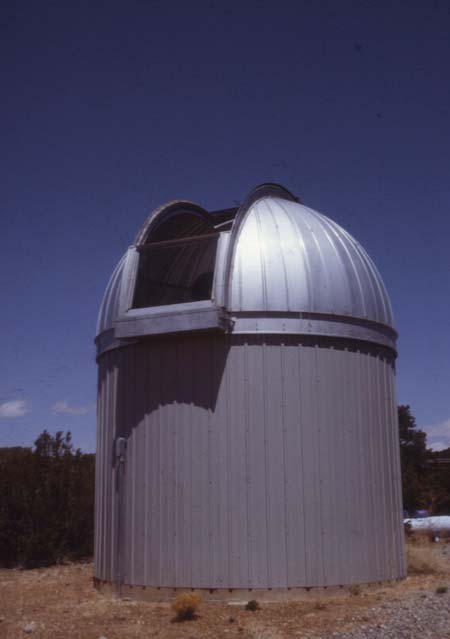
Windowpane Observatory's first home outside Santa Fe, NM, in 1988. Photo credit: WPO
The observatory dome is a 17 foot Ash Dome with the Lanphier Shutter System. The Lanphier shutter is a 4 ft. square pane of optical quality glass that allows the interior of the dome to be climate controlled. Hence, the name Windowpane Observatory or WPO. There are only 9 observatories in the world with the Lanphier Shutter as the concept is poorly understood and untested.
Armed with assurances from the manufacturer, WPO achieved great success using the Lanphier optical glass that climate-controls the observatory even with large temperature differences up to 70 degrees F. between the outside of the dome and the interior temperature. Most astronomers believed this to be impossible due to heat radiation off the glass plate. Extensive testing at the high altitude site proved that because heat was radiating evenly across the entire surface of the glass images were not blurred working to powers of 300X. The Windowpane Observatory glass plate became the subject of several research studies in climate controlled observatories and was presented in a series of papers and lectures at the University of Texas McDonald Observatory.
They key to high resolution was to make sure that the flat plane of the primary mirror was exactly parallel to the plane of the windowpane optical glass portal. In addition to protection from the elements, the windowpane glass portal eliminated the problem of wind tunnelling from high wind gusts as the entire dome environment was draft free. Before relocating to Ajo, AZ, Windowpane Observatory was operating at 8,000 ft. outside Santa Fe, NM with an Antarctic package that allowed snow loads up to 10 ft.
Now the telescope has been moved to Ajo and the observatory that got its name from its viewing portal window pane has excellent ambient temperatures 8 months out of the year.